Why is it necessary to look inside the furnace?
When we talk about furnace monitoring, we might imagine "monitoring the furnace temperature." Of course, temperature is an important control item. However, in actual manufacturing processes, there are times when we want to check not only the temperature values but also the conditions inside the furnace itself.
Observe the flames and the state of combustion.
In facilities involving combustion, such as cement kilns and waste incinerators, it's not just the temperature at a given location that matters; whether the flame is present and whether there are any changes in the combustion state are also crucial management points.
Check the materials and firing conditions.
Inside a furnace, the manufacturing process progresses through heating, firing, and melting of materials. For example, in a rotary kiln, the material moves inside as the furnace rotation. In addition to temperature, understanding the state, movement, distribution, and accumulation of the material can be helpful in determining the manufacturing process.
To detect ignition or abnormal conditions early.
Monitoring isn't limited to just the inside of the furnace. Materials immediately after leaving the furnace are still at high temperatures and may ignite or accumulate abnormally during transport to subsequent process. Early detection of these conditions can not only improve quality but also contribute to stable equipment operation and prevent problems from occurring.
What problems arise when the inside of the furnace is not visible?
If you don't understand what's happening inside the furnace, it becomes difficult to detect changes in conditions or abnormalities at an early stage. Temperature readings alone may not adequately capture the state of the flame, the movement of materials, or abnormal deposits. As a result, there is a risk of delays in noticing changes in the manufacturing process, delays in understanding the impact on quality, delays in detecting equipment malfunctions, and even equipment failures or operational shutdowns.
The purpose of furnace monitoring is not simply temperature control. A crucial objective is to understand "what is happening inside the furnace" and to manage the manufacturing process and equipment accordingly.
Why is it difficult to see inside the reactor?
Even if it's necessary to view the inside of a furnace, simply installing a standard camera won't solve the problem. This is because the inside of a furnace is an extremely harsh environment for measuring instruments.
high temperature environment
The furnace is extremely hot, and it's not possible to place typical cameras or electronic devices directly inside. Not only the camera, but also the lens and peripherals need to be protected from the heat.
dust and smoke
Depending on the equipment, dust and smoke may be generated, making it difficult to adequately check the internal conditions visually. Furthermore, if dust adheres to optical components such as lenses, it becomes difficult to maintain stable monitoring.
Influence of water vapor, gases, etc.
Depending on the equipment, water vapor and gases may also be present. Water droplets, dust, smoke, and water vapor should be avoided as much as possible in sight path, and if this is unavoidable, countermeasures such as air purging will be necessary. Furthermore, vibration, external thermal radiation, and dew condensation must also be considered in order to ensure stable monitoring.
In reactor monitoring, it's necessary to consider not only "what to monitor" but also "how to continue monitoring."
Methods for understanding the conditions inside the furnace and monitoring using thermal imaging.
There isn't just one way to manage the inside of a furnace. Depending on the equipment and purpose, thermocouples, radiation thermometer, thermal imaging, and other methods are used. The important thing is not which method is superior, but that the appropriate method differs depending on what you want to know.
| method | What you will mainly understand | Key points to consider when monitoring inside the reactor |
|---|---|---|
| Thermocouple | Temperature at a specific location | Contact sensors are widely used in industrial furnaces. However, it is difficult to understand the flame state, material movement, and temperature distribution over a wide area from a single value. Depending on the equipment, the protective tube itself may be exposed to harsh environments, such as corrosive atmospheres. |
| Infrared Radiation Thermometers | The temperature of the target object | It can measure temperature remotely and non-contact, making it effective for high-temperature objects. However, it is primarily a measuring instrument for determining the temperature of a targeted object, and is not intended for observing the temperature of a wide area. |
| Thermal Imaging | Temperature distribution | Temperature can be perceived as a surface, allowing you to visualize high-temperature areas and changes in state as images. |
From "measuring temperature" to "viewing as an image"
To determine where high temperatures are located and what the temperature distribution is like across a wide area inside a furnace, it is necessary to capture temperature as a "surface" rather than a "point." One such method is thermal imaging. By using a camera that captures thermal radiation in the near-infrared region, it is sometimes possible to capture high-temperature objects as images. By display the detected thermal energy as a thermal image, the temperature can be viewed not as a single number, but as a temperature distribution on the screen.
Viewing by point
Check the temperature of a specific location numerically.
View from a surface
The temperature distribution is viewed as an image to identify high-temperature areas and changes in the state.
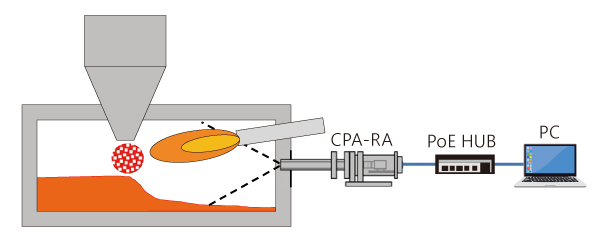
In-core monitoring device and relay lens
A furnace monitoring system is used to monitor the inside of a high-temperature furnace using images. Since it is difficult to place a regular camera directly inside a high-temperature furnace, it combines optics that transmits thermal radiation from inside the furnace to the camera with a mechanism to protect the equipment from heat.
What is a relay lens?
Simply put, a relay lens is optics that transmits thermal radiation from inside a furnace to a camera outside the furnace. Instead of placing the camera itself inside the high-temperature furnace, the relay lens is introduced near the furnace wall, and the camera captures the inside of the furnace beyond that point. By configuration optics and the camera, the high-temperature inside of the furnace can be monitored from outside.
Protecting equipment from high-temperature environments
Relay lenses and cameras are exposed to high-temperature environments, so cooling and protection mechanisms are necessary. Furthermore, dust and other particles adhering to optical components can make stable image capture difficult, so measures such as air purging are combined depending on the equipment conditions. A furnace monitoring system is not simply a camera mounted in the furnace; it's a device that combines optics for viewing the inside of the furnace with a mechanism to protect it from harsh environments.
What to see, what kind of facilities are available, and what to check.
Simply installing an in-reactor monitoring system doesn't automatically tell you the condition of the equipment. What's important is to consider in advance "what needs to be monitored in this equipment?"
Key control points to monitor inside the reactor
- Flame/Combustion State: Is the flame present normally, and is there any change in the combustion state?
- Materials and firing conditions: The state and movement of the materials, and the state of the firing process.
- Abnormal deposition: Is the material being deposited in an unusual location?
- Ignition/Abnormally High Temperature Area: Ignition during process such as the transport of high-temperature materials, or localized high-temperature conditions.
- Temperature distribution: Where in the furnace is it hot, and where is it cold?
What kind of equipment will it be used in?
In-furnace monitoring is not a technology limited to specific industries; it can be considered if there is a need to "confirm what is happening inside high-temperature equipment."
| equipment | Image of surveillance |
|---|---|
| Cement rotary kiln | Flames, firing conditions, material condition, etc. |
| waste incinerator | Combustion state and conditions inside the furnace |
| glass melting furnace | High-temperature melting process |
| Steel and heating furnaces | Temperature distribution and heating conditions inside the furnace |
| Heat treatment furnaces / Sintering furnaces | Heating/baking conditions (if within the measurement temperature range) |
You can't decide based on catalog specifications alone.
In furnace monitoring, applicability cannot be determined solely by the target temperature. The necessary configuration varies depending on the following equipment conditions:
| Confirm | Why is it important? |
|---|---|
| Installation position | The visible range and objects change depending on where you are viewing them from. |
| Measured distance | It depends on field of view and the size of the object being measured. |
| Dust, smoke, water vapor | This can sometimes obstruct the optical path. |
| Ambient temperature | This relates to cooling methods that protect the camera and optics. |
| Target of surveillance | The necessary configuration will differ depending on whether you are "observing the flames" or "observing the temperature distribution." |
It's important to check not only the maximum temperature the device can measure, but also whether you can actually see what you want to see in the actual equipment.
Chino's reactor temperature monitoring system "CPA-RA"
Chino has been providing equipment that uses relay lenses to capture thermal radiation from inside the furnace and monitor the conditions inside the furnace as an image. The CPA-RA furnace temperature monitoring system is the successor model to that system.
A relay lens is introduced into the furnace to monitor the temperature distribution over a wide area as a thermal image. The high-pixel 720x540 pixel sensor allows for a clearer configuration of the temperature distribution inside the furnace.
Main specifications
| Wavelength | 0.9μm (near infrared) |
|---|---|
| Number of pixel | 720×540 |
| Measurement temperature range | Low temperature type: 700-1450℃ (4 settings) / High temperature type: 1200-2550℃ (5 settings) |
| Accuracy ratings | ±2% of measured value |
| Frame rate | 30Hz *May vary depending on operating environment and conditions. |
| Relay lens length | 300mm/440mm/620mm/840mm/1040mm |
| Field of view angle | 45°/60°/90° |
| Power supply and connections | PoE (Power over Ethernet) / Up to 4 devices per system |
The relay lens length and field field of view are selected according to the size of the furnace, the measurement distance, and the area to be monitored. Additionally, the "CPA-RAS" model is also available in the same series for measurements taken from outside the furnace through a window.
Examine thermal images from various perspectives.
The high-temperature thermal imaging software (CPY-VXGR) supports spot/line/area measurement, trend display, emissivity compensation, and data storage. Beyond simply display thermal images, it allows you to focus on specific locations to check temperature and track changes over time.
PoE support simplifies system configuration.
PoE allows power supply and communication to be handled through a single LAN cable, simplifying wiring. Up to four devices can be connected to one system, supporting configuration that monitor multiple locations.
View the product page for the CPA-RA furnace temperature monitoring device.
Frequently Asked Questions about In-Factor Monitoring
What is the difference between in-furnace monitoring and in-furnace temperature measurement?
Furnace temperature measurement primarily focuses on determining the temperature. On the other hand, furnace monitoring sometimes aims to capture temperature distribution and other data as images to understand changes in the furnace's internal conditions.
Can't we monitor the inside of the reactor using radiation thermometer?
radiation thermometer are an effective non-contact method for measuring temperature. On the other hand, if you want to capture an image of a wide area inside a furnace and check the temperature distribution and changes in conditions, thermal imaging monitoring may be more suitable.
Can in-furnace monitoring systems be used in any type of furnace?
The same configuration cannot be used for all equipment. It is necessary to consider the application method after confirming the actual equipment conditions, such as temperature, measurement distance, field of view, dust and smoke, and installation location.
What should we consider first when monitoring inside the reactor?
First, I recommend clarifying "what you want to see," "why you want to see it," and "what problems arise from not being able to see it."
Summary: There are other things to observe inside the furnace besides "temperature".
Measuring temperature and understanding the conditions inside the furnace are not necessarily the same thing. If you currently have the challenge of "not knowing what's happening inside the furnace," then monitoring methods that involve "seeing" the inside of the furnace itself, in addition to temperature measurement, become an option. Understanding the concept of furnace monitoring can help you notice management points that you hadn't noticed before.
CONTACT
For those who want to monitor the conditions inside the furnace
In furnace monitoring, the appropriate method varies depending on what needs to be monitored, such as flame, material, firing state, accumulation, ignition, and temperature distribution. It is important to consider the application method based on the actual facility conditions, including high temperature, dust, measurement distance, and installation location.
Consult about monitoring inside the reactor.