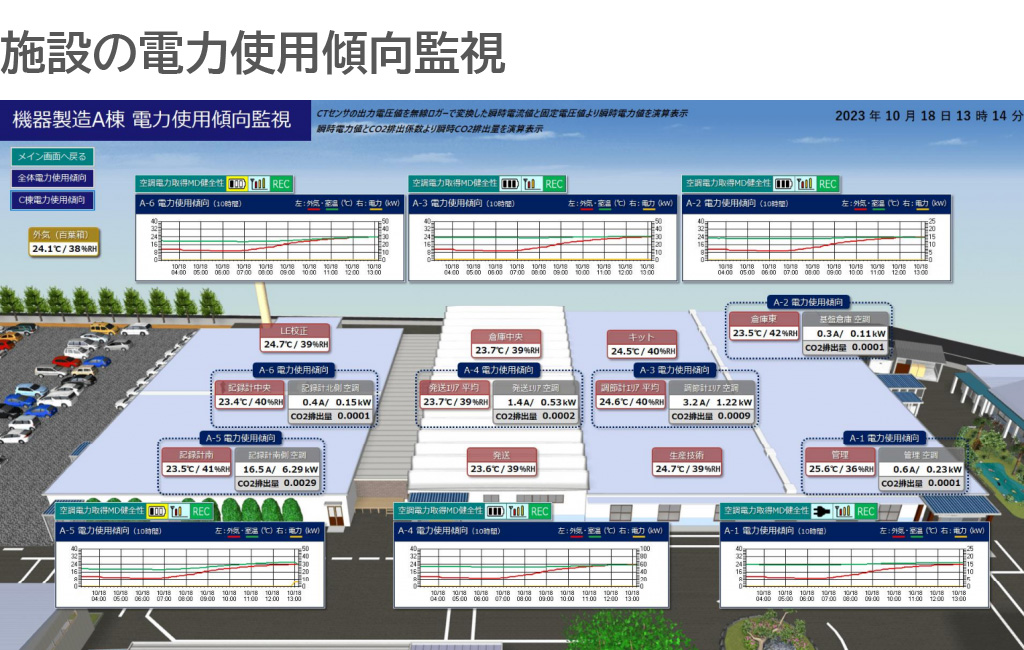
Facility visualization (environmental measurement and power monitoring)
This is related information that organizes the concept of visualization, including environmental measurement and power monitoring.

Do you know what's happening in your warehouse or storage area at 2 AM?
In manufacturing and logistics, the practice of having staff regularly inspect the premises and visually check and record temperature/humidity readings remains in place. However, this method only allows for checks during inspections, leaving periods of darkness such as nighttime and holidays.
In particular, in workplaces handling products sensitive to temperature/humidity changes, such as food, pharmaceuticals, and precision equipment, this downtime can lead to quality risks and economic losses.
This page outlines what changes can be achieved by utilizing IoT for temperature/humidity monitoring, what challenges it is suitable for, and provides an example configuration proposed by Chino.
更新日:2026.05.27
In many workplaces, temperature/humidity are checked through patrols two to three times a day. While this method is simple, it doesn't capture what happens between patrols.
Even if temperature or humidity deviates between the morning check and midday, or between the evening check and the next morning, the deviation won't be discovered until the next inspection. This gap poses a significant challenge in quality control.
In environments handling products sensitive to temperature/humidity changes, any downtime can directly translate into quality risks.
These are all cases where the impact could have been mitigated if the abnormality had been detected earlier. Therefore, in temperature/humidity management, it is important not only to "record" data, but also to "be able to identify abnormalities early."
To mitigate these challenges, a continuous monitoring system that doesn't rely solely on human patrols is effective. Utilizing IoT makes it easier to achieve the following operational needs:
The important thing is not simply to place sensors, but to set up a monitoring system that includes notification, recording, confirmation, and decision-making.
This configuration proposed by Chino is an IoT solution that automatically monitors and records temperature/humidity conditions in factories and warehouses, supporting the identification of abnormalities and the streamlining of daily management.
The problem of gaps in temperature/humidity management is a common challenge in many workplaces. However, continuous monitoring using IoT makes it easier to detect anomalies early, automate recording, and streamline reporting.
The key is not simply to improve efficiency, but to design a monitoring system from the perspective of how to reduce quality risks. 24/7 visibility is valuable for both quality assurance and business improvement.
Contact usIf you have any problems with temperature/humidity control, please contact us.
If you have any problems with temperature control,
please feel free to contact us.

If you register as a CHINO Web member, you will be able to view the product's instruction manual.
If you wish, we will send you the latest information on CHINO products via email.
You must be a login to download.